We had the pleasure of speaking with our TSL ambassador, Tony Bevre, a Yooner specialist. Discover his moving story through an inspiring journey! A passionate advocate of the Yooner, Tony continues his mission with unwavering dedication and determination!

MEETING AN AMBASSADOR – TONY

TONY BEVRE

Hello Tony, could you introduce yourself?
I’m Tony, 43 years old, and a father to a 12-year-old daughter. I’ve been living with my partner for 20 years. As a TSL ambassador, I’ve been representing the brand for about a year and a half to two years. For the past five years, I’ve been a tennis teacher and a Para-Tennis ambassador at the Seine-et-Marne departmental committee. Before that, I worked for many years as a sales manager in the automotive industry.
What does your role as a Yooner ambassador involve, and what are your main responsibilities?
My role is to shine a spotlight on the Yooner, making it visible on social media and at ski resorts. For the past two years, I’ve been promoting these products locally, mainly around my hometown of Perpignan. The resorts in the Pyrénées-Orientales, about 1 hour and 15 minutes from my home, are my primary areas of activity.
How did you discover the Yooner?
I was introduced to the Yooner at Le Grand-Bornand. To give some background, I have a neuromuscular disease that limits my ability to stand for long periods due to muscle weakness and neurological issues. This also makes long drives impossible, so I prefer working remotely. My ability to stay on my feet varies greatly—some days I can only stand for 5 minutes, other days 10.
Because I couldn’t stand for long, I had to give up skiing. I explored other activities like ski-biking, but I found it unsafe due to braking issues, especially when passing other skiers, including children. One day, during a visit to Le Grand-Bornand, I saw someone on a Yooner while riding the chairlift. Intrigued, I rented one for a trial day and absolutely loved it.
I started on a blue run with my wife, and in just two hours, I realized that despite my disability, I could enjoy the activity with her while seated. I could descend at the same speed safely and independently. I briefly stood only to use the lifts; otherwise, I propelled myself with my arms. It gave me freedom and autonomy I couldn’t get with other adapted equipment.
How do you define the Yooner? And in one word?
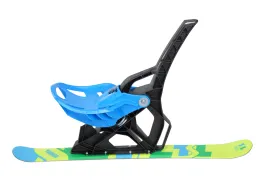
For years, I’ve noticed a communication mistake—often resorts equate the Yooner with a sled, but it’s very different. A sled is used for fast downhill runs, whereas the Yooner is more like sit-skiing, similar to Paralympic ski equipment. I compete and teach wheelchair tennis, where I am fully autonomous, and that’s the same autonomy I seek on the slopes.
I don’t use traditional skiing or dualski because that would require an instructor behind me for the lifts, which reduces my independence. The Yooner allows me to maintain that freedom. I control my speed and turns while seated, so in one word: the Yooner is sit-skiing!
What equipment is needed to practice the Yooner safely?
Compared to other snow sports, the Yooner offers more flexibility. On the slopes, you need ski pants and a jacket, but you can choose different types of footwear. I personally use high-quality boots since I barely use my legs; I rely on my core for turns and braking. I initially tried cheaper boots, but they wore out quickly. Now I use premium ski boots that have lasted me five years.
In practice, you don’t need specialized Yooner gear. A ski jacket, pants, boots, and a helmet are enough. It’s lighter, easier to carry, and more accessible than skiing or snowboarding, which require more expensive and specific equipment.
How does the Yooner help promote tourism in ski resorts and mountain regions?
The Yooner adds variety to mountain activities, which can boost tourism. It attracts new visitors and gives experienced skiers a fresh experience. For example, my wife, an experienced skier, switched to the Yooner for a season and loved it. It’s refreshing for the slopes.
In areas less familiar with the Yooner, like the Pyrénées-Orientales, it’s very accessible—after half a day, you’re ready to try it without lessons or instructors. This opens doors for those wanting to experience new mountain sensations and can energize local tourism.
Is the Yooner suitable for beginners, or does it require prior experience in snow sports?
For me, it was a complete discovery. I grew up in Burgundy with little skiing opportunity. My first experience with snow was cross-country skiing on a school trip at around age 12. I didn’t try alpine skiing until later, so when I started Yoonering, I was a total beginner.
What major events or competitions are there for Yooner enthusiasts?
There used to be an annual Yooner competition in Praz-sur-Arly, which I unfortunately never attended. It was a festive gathering with a competitive edge and medals. I think it could be exciting to develop regional or departmental championships—it would be great for enthusiasts across France.
How do you see the future development and popularity of the Yooner?
I believe the Yooner has huge potential. Proper communication is key—I present it as sit-skiing rather than a sled. Some resorts are hesitant, perhaps due to past experiences with inexperienced riders. But I always practice safely, just like skiing or snowboarding.
I’ve been in contact with resort directors for two years. Some know nothing about the Yooner, others are unsure how to classify it. I often offer to demonstrate and explain it to them, making it easy for them to understand and promote this sport.
FOLLOW TONY’S EXAMPLE—JOIN THE YOONER COMMUNITY!